
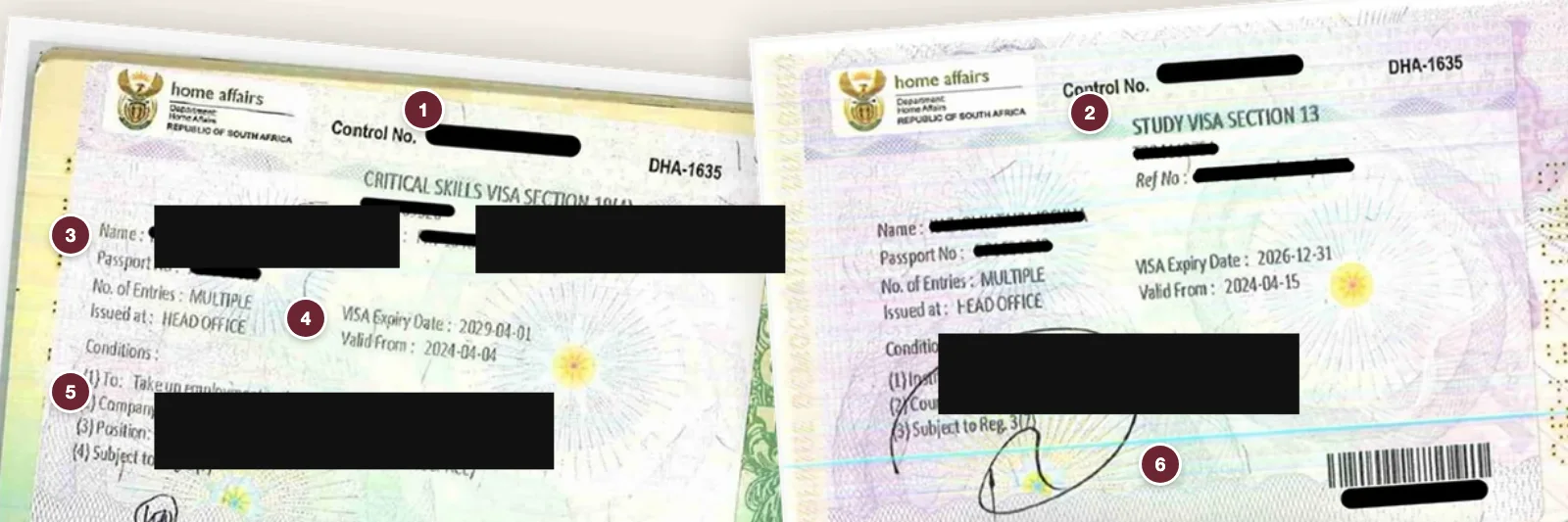
Most people check the category on their visa, see the words "critical skills" or "study", and stop there. That is only half of what binds you. A South African visa carries two things, and neither one displaces the other: the category it was issued under, and any conditions attached to it when it was granted.
Section 1 of the Immigration Act 13 of 2002 defines status as the status of the person as determined by the relevant visa or permanent residence permit granted, and section 10(2) provides that a visa is issued as one of the categories contemplated in sections 11 to 23, each of which sets out the activity that category covers. The category is the legal instrument, not a heading over it.
Conditions sit on top of the category. Section 10(5) allows the Director-General, for good cause, to attach reasonable individual terms and conditions to a visa, and regulation 9(7) of the Immigration Regulations, 2014 describes these as matters such as limitations on the type of activities that may be undertaken in the Republic and the places where those activities may be undertaken. Conditions can also work the other way and add something rather than take it away: regulation 11 provides that an authorisation to work under section 11(2) is, if approved, endorsed on the visitor's visa.
Section 43(a) ties the two together. It requires a foreigner to abide by the terms and conditions of his or her status, including any terms and conditions attached to the relevant permit by the Director-General upon its issuance, extension or renewal, "and that status shall expire upon the violation of those conditions". On the wording of the section, the expiry follows the violation.
This guide sets out what the categories mean, what endorsed conditions do in each of the main ones, how the validity dates work, and what to do if something on your visa looks wrong. It describes the elements of a visa rather than where they appear on the page: the Department of Home Affairs does not publish a layout specification, and outcomes reach holders in more than one physical form.
What the two example labels above show
The picture at the top of this page is two genuine visa labels with the personal details covered over. There is no published layout specification, so treat this as an illustration of one pair of documents rather than a template. On those two examples the numbers mark:
- The control number, and the stationery designation printed on the label.
- The category and the section it was issued under, here a critical skills work visa under section 19(4) and a study visa under section 13.
- The holder's name and passport number, alongside a reference number.
- The number of entries, the "Valid From" date and the visa expiry date.
- The numbered conditions block, which on the study example names the institution and the course.
- A signature for the Director-General, and the barcode.
The category and the section it was issued under
The category names the section of the Immigration Act under which the visa was issued, for example a critical skills work visa under section 19(4) or a study visa under section 13. In broad terms:
- Section 11: visitor's visa. Section 11(1)(a) is the short visit; section 11(1)(b) covers longer stays for prescribed activities. The remote work visa is a visitor's visa under section 11(1)(b)(iv), not a separate category.
- Section 13: study. Section 14: treaty. Section 15: business. Section 16: crew. Section 17: medical treatment for longer than three months. Section 18: relative's visa.
- Section 19: work visas. Section 19(2) is the general work visa, 19(4) the critical skills work visa, 19(5) the intra-company transfer.
- Section 20: retired person. Section 21: corporate. Section 22: exchange. Section 23: asylum transit.
Two things trip people up here. First, regulation numbers are not section numbers: in the Immigration Regulations, 2014 the work visa is regulation 18 and the study visa is regulation 12, each one lower than the Act section it implements. Second, permanent residence is granted by a permanent residence permit under sections 26 and 27, not by a visa, so "permanent residence visa" is not a thing.
What the conditions on your visa restrict you to
What the endorsement on your visa restricts you to depends on the category, so read it rather than assuming.
Work visas are endorsed with the employer, and regulation 18(9)(a) requires that employer to ensure the holder is employed only in the specific position for which the visa was issued. Study visas are tied to a named learning institution: regulation 12(1) requires acceptance at that institution, which is why registering at a different one calls for a change of conditions application to the Department of Home Affairs. Regulation 12(4) provides that a study visa lapses if the holder fails to register with, or is de-registered from, the institution concerned.
Many other categories name nothing of the sort. A relative's visa is subject to section 18(2), under which the holder may not conduct work unless an authorisation has been endorsed on the visa. A visitor's visa is limited to the purpose for which it was issued, and short-term work is only permitted where a section 11(2) authorisation has been endorsed on it. Endorsements can also be restrictive rather than descriptive, for example wording that bars a change of status.
The practical orientation is to read the category and every condition together, and to treat both as binding. If you are not certain what your own endorsement permits, do not guess from a general guide. Have the actual wording read by an admitted immigration practitioner before you take up work, register to study or change employer.
Your details and your reference number
Compare your name against the passport bio page character for character, and check that the passport number shown is the number of the passport the visa is in.
Your application also carries its own reference. The Home Affairs application form for temporary residence includes a track and trace reference for official use, and the Department's notice of decision carries a reference number. Where an application is lodged through VFS Global, the applicant is given a reference number that is used together with the surname to follow the application's progress.
A number printed on a visa or permit that has already been issued is not necessarily the same number as the application reference. If an office, an employer or an institution asks you for a number and you are not certain which one is meant, ask them to confirm which reference they need, or check directly with the Department of Home Affairs or VFS Global.
Entries
The number of entries reflects what was applied for. The prescribed application form for a port of entry visa, Form 11 (DHA-84), offers three options: Single, Two and Multiple. So "multiple" on an issued visa is a real prescribed value, not shorthand.
The dates, and why the entry stamp matters more than you think
A visa issued outside South Africa does not by itself let you be in the country. Section 10(3) provides that a visa issued outside the Republic "is deemed to be of force and effect only after an admission". Regulation 9(6) is more specific: a visa issued at a foreign mission must be affixed to the passport and is only valid once an entry stamp has been affixed at the port of entry, and the date of that entry stamp is the effective date. Regulation 11(6)(b) adds that the period of validity is calculated from the date of admission.
The Department's own guidance says the same in plain language: on entry the period of validity is calculated from the date of entry, and it is set out under the conditions on the visa. It also states that the visa allows you to travel to a port of entry, where an immigration official then determines whether you may enter and for how long on that visit.
So the expiry date is an outer limit on the document, not automatically the last day you may lawfully be present. Work from the entry stamp and the conditions together.
The wording used for the earlier of the two dates has changed over time. Immigration Directive No. 19 of 2016 records that from 1 August 2016 temporary residence visas printed through the Visa Adjudication System show "Valid From" in place of "Issue Date", and it reproduces specimen labels. Read the earlier date as the point from which the document has effect, not as the day your permitted stay begins.
What is published about the document itself, and what is not
The code DHA-1635 has been seen on permit labels that Home Affairs affixes in a passport, including on an Angolan Special Permit issued under section 31(2)(b) of the Act, and the designation has also appeared as DHA-1635A. It is a printed stationery designation, not one of the application forms prescribed in Annexure A to the Immigration Regulations, 2014, which sets out Forms 1 to 45 and pairs each with a DHA or BI code, for example Form 8 (DHA-1738), Form 9 (DHA-1740) and Form 11 (DHA-84). A text search of that Annexure returns no occurrence of 1635. If the exact code on your own document matters for a submission, read it off the document or confirm it with Home Affairs.
The Department does not appear to publish a consolidated, field-by-field guide to the visa label, and we have not been able to locate one. Because the label is not among the prescribed forms, there is no gazetted specimen or official description of each field. Individual elements have been explained in departmental directives from time to time, as Directive No. 19 of 2016 did for the "Valid From" wording. A published redacted specimen of one Home Affairs permit label shows a control number, a barcode and a signature for the Director-General, which is consistent with section 10(1), under which a visa is issued by the Director-General, but a single specimen is not a specification and you should not assume every visa carries the same elements in the same form. Government Printing Works, a government component reporting to the Department of Home Affairs, does the security printing of national documents including visas.
What conditions do in practice
Some visas carry an endorsement referring to regulation 3(7). No official Department of Home Affairs explanation of that endorsement could be located. The regulation itself is public and reads: "Whenever it appears to the Director-General that a visa was acquired through error, misrepresentation or fraud, he or she shall withdraw the visa and, where applicable, cause criminal charges to be laid against all parties implicated in the misrepresentation or fraud." Two points are worth noting. The duty is expressed as "shall withdraw", not "may". And "error" is a listed ground in its own right, separate from fraud. Regulation 3(7) sits inside a regulation headed for spousal relationships but is drafted in general terms, so treat the wording as the reliable part and do not assume a settled interpretation of its reach.
The consequences of acting outside the conditions are structural rather than discretionary. Status expires under section 43(a). A person in the Republic in contravention of the Act is an "illegal foreigner" as defined in section 1(1), and section 32(2) provides that an illegal foreigner shall be deported. Regulation 27(3) sets the undesirability periods for overstay: up to 12 months where the overstay does not exceed 30 days, two years for a second overstay within 24 months, and five years where the overstay exceeds 30 days. Note that a 31 day overstay already falls into the five year band.
Employers and institutions carry their own exposure. Section 38(1) bars employing a foreigner whose status does not authorise that employment, or in a capacity different from that contemplated in the status. Section 39(1) applies the equivalent bar to learning institutions.
The lawful route when circumstances change is section 10(6), which allows an application to change your status, or the conditions attached to your visa, or both. The Home Affairs form for this, Form 9 (DHA-1740), is described in the Regulations as an application for change of conditions on an existing visa or change of status. The fact that the Act keeps status and conditions separate in this way is the clearest sign that both matter. Be aware of section 10(8), which provides that an application for a change in status does not itself provide a status or entitle the applicant to remain pending the decision. If your employer, your position or your institution is changing, get case-specific help before the change takes effect rather than after.
Common misreadings
- Reading the category and ignoring the conditions endorsed on the visa, or reading the conditions and assuming the category no longer matters. Both bind.
- Assuming the expiry date is the last day of permitted stay, when the entry stamp fixes the effective date for a visa issued abroad.
- Reading a regulation number as an Act section number, for example taking "regulation 18" to mean the relative's visa when it is the work visa.
- Assuming a relative's visa allows work. Section 18(2) provides that the holder may not conduct work unless an authorisation has been endorsed.
- Assuming the study visa work allowance is unlimited. Regulation 12(3) permits part-time work of not more than 20 hours per week, and only for higher education and FET college students.
- Assuming a number printed on an issued document is the same reference an office is asking for.
- Saying "permanent residence visa" when the instrument is a permanent residence permit.
If a detail on your visa is wrong
Check the document as soon as you receive it, and act quickly if something is out, because related deadlines are short.
VFS Global, through which the Department states that all immigration related applications are done, lists "Transfer And Rectification Of Temporary Resident Visa" as a live application category. That is the correct term to use: rectification. No published deadline specific to a rectification was found in the Act, the Regulations or on the official sites, so do not rely on there being one.
Where what looks like an error is in fact a decision, for example the wrong category, or conditions you did not apply for, a statutory clock may already be running. Section 8(4) gives an applicant 10 working days from receipt of the notification to apply to the Director-General for review or appeal, and section 8(6) gives a further 10 working days to take it to the Minister. A refusal of entry or a finding that you are an illegal foreigner at a port of entry follows a different route, with a request to the Minister within three days under section 8(1)(b). The Act sets no deadline for the Department to decide, so no turnaround time should be assumed.
Separately, regulation 9(5)(a) requires a change of status or conditions application to be lodged no less than 60 days before the visa expires, and regulation 9(8)(c) applies the same 60 day period to extensions.
Use verified channels only. The Department's Contact Centre is 0800 60 11 90. VFS Global's South Africa helpline is +27 12 425 3000, operating Monday to Friday, 08:00 to 12:00 and 13:00 to 17:00. Note that the Department's online status verification service carries a notice that it has been suspended until further notice, and no official public online tool for verifying an issued visa was found. Sites that present themselves as official verification services but are not on a gov.za domain should be treated with caution. If you suspect a visa in your passport is not genuine, get help before you travel on it: section 29(1)(f) makes a person found in possession of a fraudulent visa a prohibited person, and section 49(14) makes fraudulent acts for the purpose of entering or remaining in the Republic an offence. Suspected corruption can be reported to the National Anti-Corruption Hotline on 0800 701 701.
Getting a second pair of eyes
If you would like someone to go through your visa with you, check each element against what you applied for, and map out renewal timing against the 60 day rules, Legalyze can help with that administrative work.
This guide is general information about what a South African visa consists of and what the Act and Regulations say. It is not legal advice on your individual circumstances, and it cannot tell you what your own visa permits you to do. Legalyze provides administrative support rather than legal representation. Where a matter involves reserved legal work, or where your own status may already be affected, we will refer you to an admitted practitioner.