
CIPC deregisters companies in bulk now. It ran a mass exercise from 2 to 23 December 2024, with final deregistration in early February 2025, under Practice Note 1 of 2025 and Gazette notice 52028 of 31 January 2025. Customer Notice 09 of 2025 calls the referral of non-compliant entities a continuous automated process.
Two filings keep a company on the register: the annual return and the beneficial ownership declaration. Practice Note 1 of 2025 states that entities not compliant with beneficial ownership declarations are prohibited from filing annual returns, so one cannot be done without the other.
An annual return is not a tax return
CIPC is explicit about this. An annual return is a summary of the most relevant information about a company or close corporation. A tax return determines tax liability to the State and goes to SARS. Two processes, under different legislation and different departments, so compliance with one is not compliance with the other.
The basis is section 33 of the Companies Act 71 of 2008 with regulation 30 of the Companies Regulations 2011, or section 15A of the Close Corporations Act 69 of 1984 with regulation 16 of its Administrative Regulations. For both, deregistration runs under section 82(3) and re-instatement under section 82(4) of the Companies Act, read with regulation 40.
Three points catch directors out. Dormant entities must still file, because neither Act distinguishes active from inactive entities. Filing is electronic only, through BizPortal, e-Services or a CIPC self-service centre. And CIPC's published position is that it cannot exempt an entity from filing, waive a legislated fee or accept instalments, since the fee must accompany the filing. One qualification sits in the regulations rather than the FAQ: regulation 30(8) lets a company inactive in the preceding financial year apply for exemption from the fee, on statements showing no turnover. The filing is not excused.
When it is due
Companies have 30 business days from the anniversary of the date of incorporation. Section 5(3) sets the counting: exclude the first day, include the last, and exclude public holidays, Saturdays and Sundays in between.
Close corporations run on a different clock, from the first day of the anniversary month until the end of the month after that.
What CIPC charges
The fee is set by turnover band, taken from the entity's latest approved financial statements, and rises if you file late. Section 223 read with regulation 164 defines turnover. These amounts are payable to CIPC, separately from any service fee.
Companies, for returns that became due on or after 1 May 2011:
| Annual turnover | Within 30 business days | Filed later |
|---|---|---|
| Less than R1 million | R100 | R150 |
| R1 million to under R10 million | R450 | R600 |
| R10 million to under R25 million | R2 000 | R2 500 |
| R25 million or more | R3 000 | R4 000 |
Close corporations have two bands: R0 to R50 million is R100 where filed within two months from the start of the anniversary month, and R50 million and above is R4 000, with a flat R150 penalty for each late lodgement in both bands. Returns that fell due before 1 May 2011 run on the older Companies Act 1973 table. Once a return is filed the information cannot be updated, so get the band right first time.
What goes with the annual return
Three things accompany the filing: the beneficial ownership declaration, the financial statements or a Financial Accountability Supplement on Form CoR 30.2, and the Compliance Checklist. Regulation 30(1), as substituted on 24 May 2023, also requires a copy of the securities register, which popular guides leave out, and regulation 30(1A) requires an affected company to file its register of the disclosure of beneficial interest. The Compliance Checklist has been mandatory since 5 March 2020, under Notice 9 of 2020, for Inc, (Pty) Ltd, Ltd, SOC and NPC companies.
Beneficial ownership: who must be declared
The regime comes from the General Laws (Anti-Money Laundering and Combating Terrorism Financing) Amendment Act 22 of 2022 and the regulations gazetted on 24 May 2023. CIPC launched the register on 1 April 2023, and filing became mandatory on 24 May 2023.
A beneficial owner is an individual who, directly or indirectly, ultimately owns the company or exercises effective control of it: through beneficial interests in its securities, control of voting rights, the right to appoint or remove directors, a chain of ownership through a holding company, trust or partnership, or the ability to materially influence management. It is always a natural person, so a company or trust cannot be one.
CIPC first asks whether the entity is an affected company: a public company, an unexempted state-owned company, a private company that transferred more than 10% of its issued securities in the preceding 24 months other than between related persons or whose MOI opts in, or a company controlled by or a subsidiary of one of those. Most owner-managed companies are non-affected, which CIPC calls the most common category, so much commentary on the affected company rules does not apply to a typical (Pty) Ltd.
The widely quoted 5% threshold deserves a caveat. Regulation 32A(1)(a) sets 5% expressly, but governs the beneficial interest register of affected companies. Regulation 32(3)(b), covering non-affected companies, requires a record of each beneficial owner and states no percentage. CIPC applies 5% administratively to both. Ownership is not the only test either: it says that where the board exercises effective control the board is regarded as the beneficial owners, and that very few companies genuinely have nothing to declare.
New entities file within 10 business days of incorporation, every entity files its latest declaration again with each annual return, and register changes are filed within 10 business days on the applicable CoR form. There is no CIPC fee: Table CR 1 lists Forms CoR32B and CoR121A as "No fee to be charged". Under Customer Notice 36 of 2026 CIPC now runs beneficial ownership inspections, on site or virtually, which directors or members must attend personally. Section 214 makes knowingly providing false or misleading information for a fraudulent purpose an offence.
What happens when you do not file
Deregistration is triggered automatically when two or more successive annual returns are outstanding. Section 82(3)(a) lets the Commission remove a company that has failed to file for two or more years in succession and, on demand, has failed to give satisfactory reasons or to show satisfactory cause to remain registered. The demand is Form CoR40.3, the Demand Notice concerning Inactive Company, allowing 20 business days to respond; Form CoR40.4 follows.
Of CIPC's four status labels, "Deregistration" and "Final Deregistered" follow the entity's own application, while "AR Deregistration" and "AR Final Deregistered" mean CIPC acted on annual return non-compliance. That is not the end. CIPC states that at the AR Deregistration stage the legal persona has not yet been removed, and that the process is cancelled if all outstanding returns are filed while the entity is still in that status, before the final deregistration date. Its beneficial ownership guidelines add that such an entity is still active and able to trade, though the same body warns that SARS, banks, government departments and service providers may already refuse to deal with it. Written objection is the route for a voluntary deregistration, not an annual return one, and since 8 December 2025 objections go through the automated online service, not the old deregistrations@cipc.co.za mailbox.
Notices go electronically to the contact details CIPC holds for active directors and members, which is why it keeps asking for their own numbers and email addresses rather than a service provider's. If those belong to a former accountant, nobody sees the warning. The letters can be downloaded from e-Services and BizPortal.
CIPC's list of consequences after final deregistration is blunt. It ceases to exist and loses perpetual existence and limited liability, the name becomes available immediately for someone else to reserve, directors can be held personally liable for the debt, banks may freeze the account, and service providers and creditors may stop dealing with it. Sections 83(2) and (3) add that removal does not affect a former director's or shareholder's liability for anything done beforehand.
Re-instatement
Section 82(4) allows any interested person to apply to reinstate a deregistered company, on Form CoR40.5, for R200 payable to CIPC.
CIPC automated the process on 11 August 2025. Applications go through e-Services, BizPortal or a self-service terminal. The old re-instatements@cipc.co.za address closed, supporting documents are no longer uploaded except with a court order, and the application is processed once card payment goes through. Court orders carry no charge, but must also mandate the entity to comply with its filing obligations. An older CIPC page still describes the discontinued email route; follow the automation notice.
Two conditions govern. The entity must have been in business or had other economic value at deregistration; that evidence is no longer uploaded but must be retained, and CIPC may demand it under regulation 168 and withdraw the re-instatement. Second, once the application is processed, all outstanding annual returns, the latest beneficial ownership declaration and the AFS or FAS must be filed within 30 business days, or the entity reverts to its deregistered status.
An annual return calculator prices each outstanding year off the turnover you enter, and payment must follow within five working days or the application is cancelled. Where the shell has nothing worth preserving, CIPC's guide points to registering a new company instead, at a R175 CIPC filing fee.
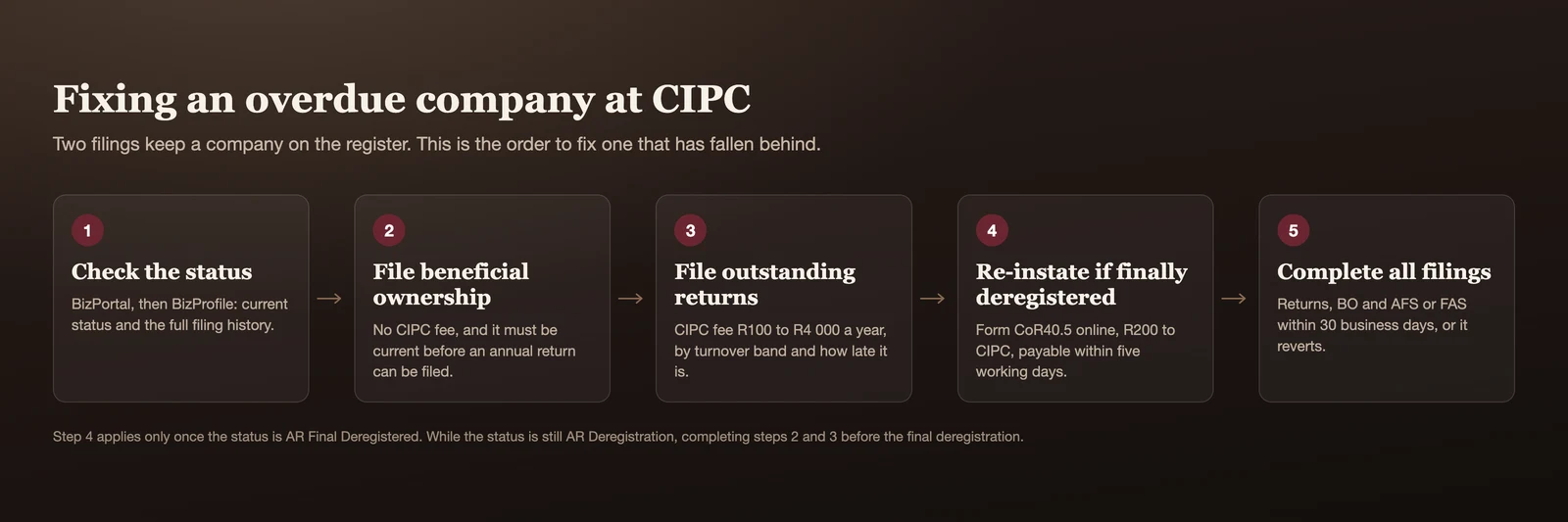
The sequence for fixing an overdue company
Gather first: a CIPC customer code on a director's own email address and cellphone number, the latest approved financial statements per outstanding year, the securities or members register, and each beneficial owner's name, date of birth, identity or passport number, addresses and email.
- Check the status. Log in at bizportal.gov.za and open BizProfile. The History tab shows every application received and processed, and the deregistration notices.
- File beneficial ownership first. It gates everything else, and CIPC charges no fee. Filing needs a written mandate on the entity's letterhead, signed by 50% plus one of the directors or all members of a close corporation, appointing a named natural person. CIPC's optimised route no longer requires it to be uploaded, but it must exist and be produced on request.
- File every outstanding annual return, with the financial statements or FAS and the Compliance Checklist, at the applicable band and late fee.
- If the status is AR Deregistration, completing steps 2 and 3 before the final deregistration date cancels the process.
- If the status is AR Final Deregistered, lodge Form CoR40.5 online for R200, pay within five working days, then complete steps 2 and 3 within 30 business days.
- Update the records afterwards. An annual return is not an amendment form. Director, address and MOI changes go on a CoR39, CK2 or other CoR form. Regulation 30(7A) allows 10 business days for changes to the name, legal type, MOI or directors, and requires 10 business days' notice before a change of registered office.
One trap throughout, in CIPC's own words: timeous payment or deposit of the fee is not itself the filing of an annual return. And CIPC action does not settle the entity's position with SARS, which runs on its own track.
Where we fit
Our Annual Returns & Beneficial Ownership service starts at R690 for one outstanding year: two years R890, three years R1,490, a standalone beneficial ownership filing R990, and the combined package R1,490. Where an entity is already finally deregistered, Company Restoration & Deregistration covers restoration at R3,490 and a voluntary deregistration at R1,990. Those are service fees; the CIPC annual return fee of R100 to R4 000 a year and the R200 CoR40.5 fee are payable to CIPC and quoted separately.
This is general information about the CIPC filing process, not advice on any particular company's circumstances. Legalyze provides administrative support, and matters that require legal representation or an opinion are referred to admitted practitioners.